
Legacy in RPGs
Final Fantasy XVI is still a Final Fantasy, but what does it mean for a series to have so many entries?

I finished Final Fantasy XVI the other day, and I was surprised that I enjoyed it. Mostly enjoyed it, anyway. I had held off playing it for a while, because I had heard that it purposefully tried to ignore (or actively beat back) its legacy. The crystals must be destroyed, not preserved. The setting is grim and bloody, more like Game of Thrones than more anime-like fantasy worlds. Clive, the protagonist, is unapologetic in his quest to destroy the crystals, grumpily marching forward with his burning sword in his hand. None of this impressed me, mostly because I’ve found that “grim” and “dark” do not necessarily mean that something is good. It didn’t help that I’m more into a sub-genre called “hope-punk,” which says it all in its name, really (Star Wars is hope-punk. Final Fantasy X is definitely hope-punk).
For I time, I was in the camp of gamers that looked down on recent entries in the Final Fantasy series. Not that they weren’t fun (I actually had a good time playing XIII, at least when it wasn’t preachy), but that they had parted in some important way that made Final Fantasy games Final Fantasy games. On the one hand, I have a lot of nostalgia for the earlier games of the series. I think most of them still hold up really well, as long as you can get past some tough loading time, and Square Enix seems to have made a conscious decision to change things up. Modern Final Fantasy games aren’t like old Final Fantasy games, and so I don’t like them as much. On a good day, that’s called preference; on a bad day, that’s called prejudice. For most of us who complain that the old is dead and gone, it’s prejudice.
Luckily, a $20 pricemark at a local gaming store helped me get over that prejudice, and I gave Final Fantasy XVI a chance. I found I liked it quite a bit (again, when it doesn’t get preachy, which it does a lot), and that it isn’t as grim and dark as it was pretending to be. It is certainly bloody, but you can have blood without the grimness. The thing is, all of Clive’s friends are really good-hearted souls who turn into a family. People tear up. They talk about their dreams. They get starry-eyed. The plot gets pretty heavy-handed at the end, but again, when Clive and his friends aren’t playing the grim, brooding type, they’re having a great time with one another and bearing their souls.
While playing the game, though, I started wondering what it really means to be a Final Fantasy game. I realized that what I was looking for was emotional connection in a particular way, connection that moved me with a very specific type of music, character, plot, and world. It’s unfair to expect modern games to do the exact same thing that their predecessor did. The people who made these modern games are not the same as those who made those on the SNES and PS1. And I’m just one player. Who says that my emotional connection to Terra or Yuna is the emotional connection I should have for Lightning or Jill?
That said, the game is called Final Fantasy, and it therefore claims some connection to the past entries. But what connection is that? What does legacy look like in video games? What does it look like in the modern world, and more specifically, what does it look like in Japan, where this game was created, and for the Japanese, for whom this game was primarily created?
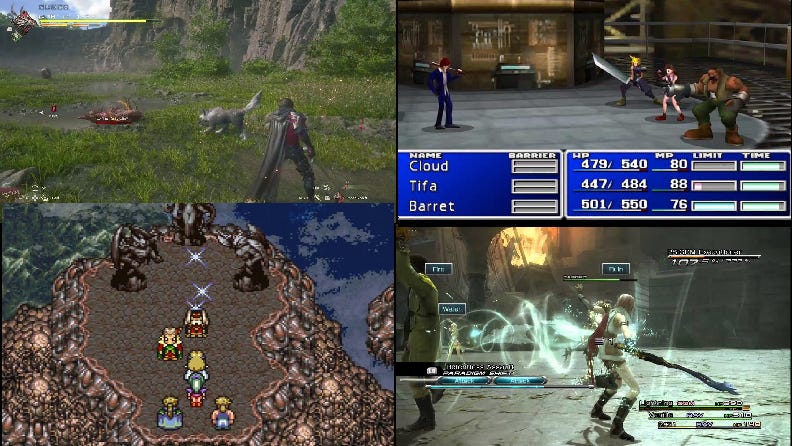
How much is a game beholden to its past entries?
Final Fantasy is pretty special in having sixteen entries. Most RPG series barely get up to five or six. Dragon Quest has eleven mainline entries, but Yuji Horii, who helmed each game, has a very different answer to what it means to have a legacy. Series like Suikoden, Wild Arms, Star Ocean have similar trajectories: the first or second game is the pinnacle, the third and fourth game try and change things up, then there’s a fifth game that tries really hard to recapture the atmosphere of the original games but doesn’t quite make it. Then the series heads to handheld systems and dies (all except Star Ocean, which keeps on trying and trying and just not getting it right). Later games in these series try to tap into their legacy, but the historical or creative moment is gone, and the creators either try too hard or else don’t try hard enough. Or just try in the wrong way.
Some series (again, like Dragon Quest) are able to push past this legacy-barrier. The first three Dragon Quest games built on each other, until the third game, which was a kind of culmination of everything that made the series great. The fourth game was a bit experimental, but still worked really well, and the fifth game is the sort of heart of the series. Subsequent games continued the legacy until Dragon Quest IX and X, which either turned the system on their head or else went online in Japan only. Somehow, Dragon Quest XI was able to mix the best of its legacy with modern expectations and is a great game. At least for Dragon Quest, getting past the legacy-barrier was to keep on making quality games, experimenting just enough to keep things interesting.
Pokemon and Atelier games, and others like them, work the same way: each is just a little bit different than the one before it. Tales games also change slightly from entry to entry, though the series is sustained mostly by its fantastic characters. Then there are games that continually change, such as those in the Mega Man franchise. Capcom produces game after game until the series feels old and tired, but then, at just the right moment, reinvents the series into Mega Man X, or Mega Man Zero, Battle Network, or Star Force. Mega Man continues as a series, then, by hiding its changes behind new settings and sometimes drastically differently play styles.
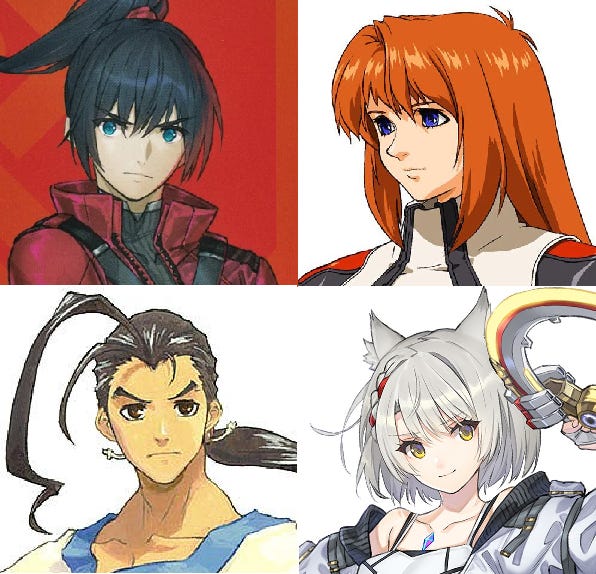
Then there is the Xeno series. Xeno games differ from other series, because the same creator, Takahashi Tetsuya, keeps trying to explore his vision on hardware or in styles that don’t do that vision justice. Xenogears is an amazing game, but it’s clearly held back by the Playstation as a machine. It was also held back by time and money constraints (and, from what I have read, constraints on the experience of his team, who Takahashi had to train up from scratch). The Xenosaga games are more like movies than games, which is great if you like the story, but it’s a slog if you don’t find Shion, KOS-MOS, and their companions all that compelling. In Xenosaga III, Takahashi was finally able to combine a great story with its lore and a great game, but I wonder how many players were able to get through the first game, with its long cut-scenes, and the second game, with its lack of dungeons and its odd character graphics. Xenoblade games were much more successful, as Takahashi found a balance between deep and heady lore with really fun gameplay.
So does the Xeno series pay homage to its legacy? I think it does, even though -gears, -saga, and -blade are such different subseries. That legacy, though, is planted firmly in the mind of Takahashi Tetsuya and his continued drive to get his vision right. Think about the relationship between Fei and Elly (or Lacan and Sofia) in Xenogears and Noah and Mio in Xenoblade III. There are clear narrative parallels, but also major differences. Fei, Lacan, and Noah are very different characters, and they make very different choices; so are Elly, Sofia, and Mio. These characters are not reworkings of one another but different iterations of the same, basic themes. Takahashi has been able to explore his vision in a variety of ways, so that he can reference prior games without making his new games just simple, cookie-cutter updates of games that already had their time in the spotlight.
The Final Fantasy legacy - if it has one
As I said above, Final Fantasy is different in that it has so many entries, but it also has diverse groups of people working on them. The creators have tried to continue the themes of Final Fantasy through each entry, so that there are shared ecological questions in VII and XVI, political questions about militaristic empire in VI and XVI or religious empire, in XIII and again in XVI. As in the Xeno games, we think about these themes differently in their different contexts. VII’s ecological questions (and, for that matter, those in VI as well) concern how humanity can damage the planet beyond its ability to heal itself, while in XVI, the ecological problem is the impetus for the quest but also has its root in more divine machinations. We learn about how to challenge problems made by humans and those that we inherit in the variety of perspectives. I think that the different representations of love in the series is particularly broad and poignant; think about Terra in VI, Squall and Rinoa in VIII, Sazh and his son in XIII, and Clive and his brother in XVI. Love is not purely romantic, but all forms of love presented lead to a character’s growth and become the foundation of their ability to face adversity.
These are themes in the plot, world, and characters, but what about the actual gameplay? Sure there is magic and eikons/espers/summons, there are Active Time Battle bars, characters gain experience and, often, ability points, and the player faces off against multiple waves of small groups of enemies and singular bosses instead of whole armies, but most of these exist in other series as well. Many people see Final Fantasy’s battle systems as being more about change than continuing a single style (as in other series which continue to hone a particular type of battle), but there are overlaps between each successive game, if not across the entire series. Some systems are tied more to characters (IV, VI, IX, X) while others are tied to the story (VIII, XIII). All use the job system to some extent, though in some games the jobs are open to all characters (V, to some extent XIII) while other games explore the jobs in individual characters. I think that XVI is interesting in that Clive is a kind of summoner but also a dark knight.
Does a game need to pay attention to its legacy?
Thinking about these connections, at least for me, makes the series more interesting. I like seeing patterns and exploring similarities and differences. I think the good, old practice of compare and contrast that most of us learned in school does a lot to dig up some of the meaning in a game - or a book, movie, or story of any kind. But does a game have to pay attention to the games that came before it? Is a game beholden to its legacy, or do creators have the freedom to do whatever they want.
Well, on the one hand, I don’t like thinking of game series as mere vehicles to sell more games. I think more people would buy Final Fantasy XVI than they would a game called Battle for Freedom or Clive the Fire God. Series that continue by tweaking a battle system or being set in the same world don’t have this problem, but Final Fantasy battle systems can be so different, and their worlds are rarely connected, that the very title Final Fantasy could be seen as a marketing tool to get more people to buy games. And certainly it has been used that way (companies want to make money, after all), but I think the games lean on each other more than just being one money grab after another.
In a way, a series of game is both a body of work and the body of work of a team’s successors. Think of it like a poet or any other artist. Basho wrote poetry and travel logs, publishing them under his name, even though they were rather different. His style developed, he used different types of poetry, he wrote some collections with his students or friends, and that single name - Basho - bound them all together. Think about the first five Final Fantasy games as the main poet, in this game, Sakaguchi Hironobu.
Then, after Basho had gained fame, he took on students. Some of those students wrote in Basho’s style, while some of them took his ideas about poetry and traveling and used it to develop their own styles. Final Fantasy VI to X represents the work of a student, in this case Kitase Yoshinori. Now, in most cases, the student never really rises to the level of the master, but I think in the case of Final Fantasy, Kitase directed game much better than Sakaguchi did. In Western fantasy, we might compare this to C.S. Lewis and J.R.R. Tolkien, who learned from George MacDonald but who were, in my opinion, considerably better authors than their teacher. That’s my opinion, at least.
So does Kitase owe anything to Sakaguchi? Does Tolkien owe anything to MacDonald? Did Basho’s students have to continue on their master’s style? Well, yes and no. Kitase and Tolkien are different people, and they have their own visions, ideas, and styles that may have been shaped by Sakaguchi and MacDonald, but are still distinct from their teachers or forbearers. I love Final Fantasy IV, but we wouldn’t have the revolution in gaming that was Final Fantasy VII if Kitase kept on making games like Sakaguchi. Final Fantasy could have continued up until the sixteenth entry if Sakaguchi’s style were the standard (look at Dragon Quest games), but the series may also have faltered like Wild Arms or Suikoden. Kudos to Kitase for parting from his forbearer.
That said, the past is not just a series of influences or lessons that we can take or leave. Our teachers have entrusted us with their wisdom, and it is our task to continue parts of that wisdom - note, parts of that wisdom. There are some things that our predecessors want to pass on that are not worthy to be continued. That’s a strong way of putting it, as if things like random battles or grinding is somehow not “worthy” or automatically “lesser” than our own modern ways (hey, maybe we’re wrong that grinding is a pain in the neck; maybe we’ve lost something in ignoring that part of our tradition). But think of it more broadly. Part of our legacy in the United States is the quest for freedom for all people, but part of our legacy is also slavery. Part of our past is democracy, but another part is empire. And those opposites - freedom and slavery, democracy and empire - are playing out in our world today. It’s our job in the United States to use our rational minds and the wisdom that we have learned both as growing communities but also from those who came before us to figure out which legacy to put aside and which legacy to carry on into the future. Games are the same.
We have been given many gifts, as people and as gamers. Some of those gifts are tremendously important. Some of those gifts bind us to terror and oppression. We can take or leave those gifts, but what we can’t do is ignore them. We can’t pretend that certain wars didn’t happen or that certain people groups were oppressed. We also can’t pretend that there wasn’t a time when you had to play battle after battle to be able to even go toe-to-toe with a boss encounter, or that the soundtrack to Chrono Trigger didn’t happen. You just can’t. These are parts of our history, however series or unserious they are. First, you can’t understand the present unless you have a firm and open understanding of the past, but the past also helps us appreciate the history of human endeavor. Final Fantasy XVI is better because VII made us consider how magic could bleed the world dry, or that love isn’t best explored between a man and a woman but by a woman and the children she’s sworn to protect. Final Fantasy’s legacy is a conversation that grows the more you know about it, and it deepens our understanding of the human condition the more games that join that conversation.